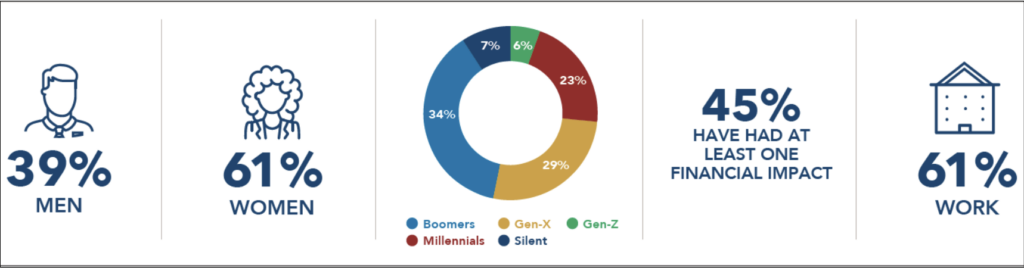
Caregiving ranges from childcare to eldercare, touches individuals from all demographics and levels of seniority, and has increased the economic and emotional toll of the employee and employer.
Caregiver Demographics
There are over 40 million adults in the US who are caregivers. One in four spend 21 or more hours a week providing care to their loved one, and one in six are employed while providing that care. Creating a caring culture, in the workplace, is no longer an option when running an organization. A caring culture is demonstrated by acknowledging its employees’ care concerns and by investing in adequate and innovative employee supports. This is an investment in the employees and the organization’s bottom line; “an investment that goes beyond dollars to include time and leadership” (Fuller & Raman, 2019).
Inadequate employee supports cost employers. These costs show up in: increased absenteeism, unplanned absences, increased turnover, decreased retention, productivity loss, and increased disability costs. Creating a caring culture in the workplace does not have to be expensive and is not just reserved for large businesses.
Image Credit to Small business caregiving guide: AARP family caregiving. Small Business Caregiving Guide | AARP Family Caregiving. (n.d.). Retrieved January 12, 2023, from https://www.smallbusinesscaregivingguide.org/the-business-case
According to the AARP Family Caregiver Small Business Caregiving Guide (n.d.):
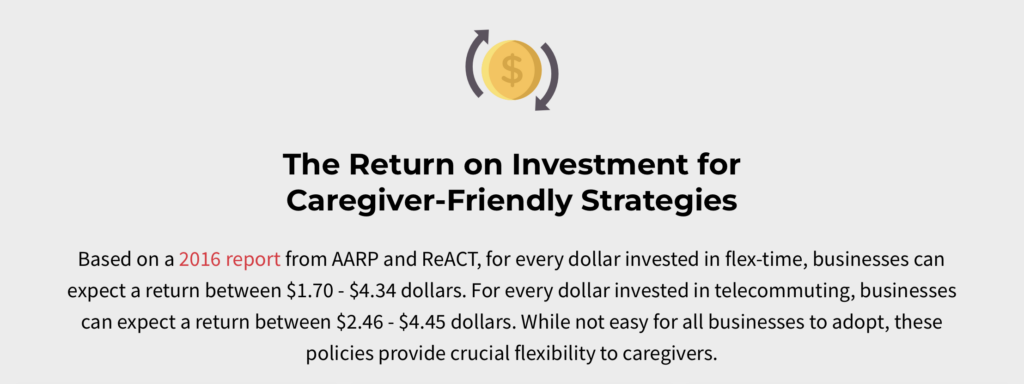
“Caregiver-Friendly Strategies, such as flex-time and telecommuting, are effective solutions to boost employee productivity because they give employees the flexibility they need to be successful at home and at work. These solutions have proven to have a real return on investment for employers.”
“Employees with caregiving responsibilities are more likely to stay with an employer who understands and supports them while they are providing care. This increases employee retention and morale. Small employers know the importance of retaining good employees who have substantial institutional knowledge and who can be difficult and expensive to replace.”
“A caregiver-friendly culture positively impacts other challenges that small employers face. Certain strategies, such as cross-training, can help small employers prepare for an employee leaving the business for other reasons than caregiving.”
(Small business caregiving guide: AARP family caregiving. Small Business Caregiving Guide | AARP Family Caregiving. (n.d.). Retrieved January 12, 2023, from https://www.smallbusinesscaregivingguide.org/the-business-case)
Check out these articles on supporting caregivers in the workplace.